

What is Value Betting? The Complete Beginner's Guide
Most people bet on football by picking who they think will win. Value betting is different — it's about finding odds where the bookmaker has mispriced the probability. You don't need to be right every time. You need to be right more often than the odds imply. That distinction is everything.
This guide explains value betting from the ground up: what it means, how expected value works, and how to actually identify value bets in real Premier League and World Cup fixtures.
How SupaBola Surfaces Value Bets Automatically
On SupaBola, we surface value bets automatically — our AI compares model probabilities against bookmaker odds across thousands of matches. Instead of manually crunching numbers, you can instantly see which fixtures have a statistically meaningful edge.

Every row on the value bets page shows the fixture, the market (e.g. Home Win), our model's estimated probability, the current best odds available, and the implied edge. Green indicates positive EV. The data refreshes daily as odds and team news update.
What is a Value Bet, Explained
A value bet is a wager where the probability of an outcome is higher than what the bookmaker's odds reflect.
Let's use a coin flip as the simplest example. If a fair coin lands heads 50% of the time, a fair bet pays 2.0 (even money). If a bookmaker offered 2.20 on heads — that's a value bet. The true probability is 50%, but the implied probability of 2.20 odds is only 45.5%. You'd be getting paid more than the risk justifies.
Football works the same way. Bookmakers set odds to reflect their estimated probability of each outcome, then add a margin (called the vig or juice) to ensure profit. When their estimate is wrong — or when sharp information isn't yet priced in — value appears.
Key insight: Value isn't about picking winners. It's about finding odds that are wrong in your favour.
How Expected Value Betting Works
Expected value (EV) is the mathematical foundation of value betting. It measures how much you can expect to gain or lose per bet, on average, over many repetitions.
The formula:
EV = (Probability of winning × Profit) − (Probability of losing × Stake)
Or simplified for a single-unit stake:
EV = (Your probability estimate × Decimal odds) − 1
- Positive EV (+EV): The bet is profitable long-term — this is a value bet.
- Negative EV (−EV): The bet loses money long-term — this is what bookmakers want you to place.
A Worked Example: Premier League
Say Manchester City are playing Brentford at home. A bookmaker prices Man City to win at 1.55 (implying a 64.5% probability).
Your analysis — based on recent form, xG data, and head-to-head records — puts City's win probability at 72%.
Calculate EV:
EV = (0.72 × 1.55) − 1 = 1.116 − 1 = +0.116
That's a +11.6% edge. Over 100 bets at this edge, you'd expect to profit 11.6 units. That's a strong value bet.
If instead your probability estimate was 60% (lower than the implied 64.5%), the EV would be:
EV = (0.60 × 1.55) − 1 = 0.93 − 1 = −0.07
Negative EV. Not a value bet, even if City are likely to win.
A Real-World Football Example: World Cup 2022
The 2022 World Cup group stage provided a textbook value bet case study. Before Japan vs Germany, Germany were priced as heavy favourites — most books had Japan at 6.00 (implying roughly 16.7% probability of a Japan win).
Japan had been building steadily under Hajime Moriyasu, pressing high and creating chances from quick transitions. Analysts with access to tactical data put Japan's true win probability closer to 22-24% — significantly higher than the implied odds.
Japan won 2-1. Bettors who identified that value were paid 6.00 on what was, analytically, a ~23% shot. The expected value was strongly positive.
This doesn't mean value bets always win — Japan could have lost and the bet would still have been correct. Value is about making decisions with the right information. Results validate over hundreds of bets, not one.
How to Find Value Bets
Finding value requires building (or using) probability estimates that are more accurate than the bookmaker's. Here's the process:
1. Estimate True Probability
This is the hardest part. You need a method. Common approaches include:
- Statistical models: Using historical form, xG (expected goals), defensive records, squad strength
- Poisson distribution: A mathematical model that calculates likely scorelines based on average goals per team
- Market comparison: Comparing odds across multiple bookmakers — large discrepancies often signal one book is off
For league football, data-rich metrics like xG allowed and xG created over the last 10 matches are significantly more predictive than raw goals. A team that's won three games but conceded a lot of high-quality chances may be overpriced for their next match.
SupaBola's predictions page shows the underlying probability estimates for each fixture — including win/draw/loss split and confidence ranges — built from 11,000+ data points per match.

2. Calculate Implied Probability from the Odds
Convert decimal odds to probability:
Implied Probability = 1 / Decimal Odds
Examples:
- 2.00 odds → 50% implied probability
- 3.50 odds → 28.6% implied probability
- 1.40 odds → 71.4% implied probability
3. Remove the Vig
Bookmakers inflate odds to ensure their margin. A 3-way market (Home / Draw / Away) with a 5% vig means the three implied probabilities add up to 105% rather than 100%. To find the "true" odds the bookmaker is offering, you need to strip this out.
Our VIG calculator does this automatically. Here is what it looks like on SupaBola — enter any set of odds and instantly see the bookmaker margin and true probabilities:
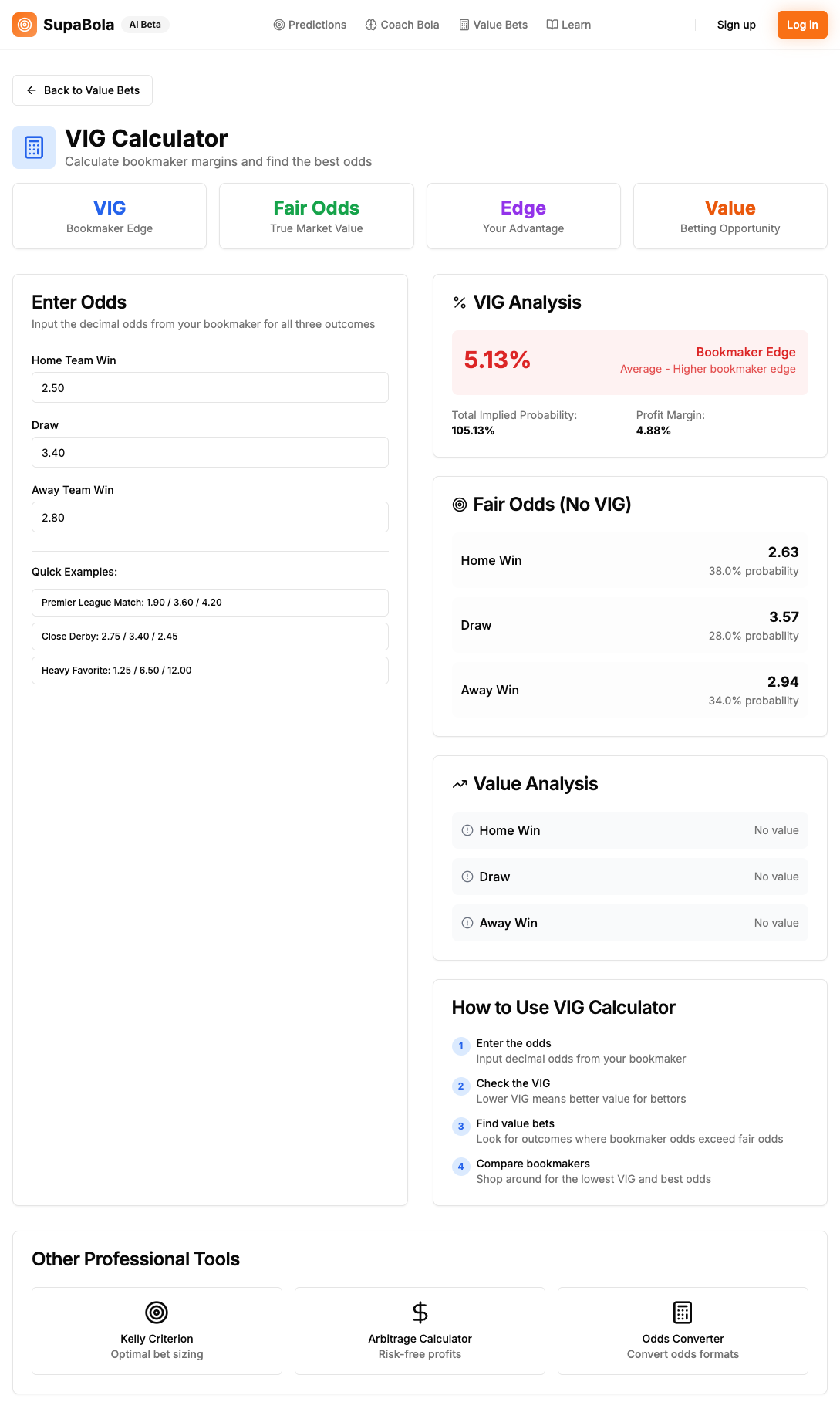
Paste in any set of odds and it tells you the bookmaker's margin and the true implied probabilities underneath.
4. Compare Your Estimate to the Market
If your model says 28% and the market implies 20% — that's potential value. The gap needs to be meaningful (at least 3-5%) to outweigh the vig and variance.
Key insight: A 2% edge sounds small, but applied consistently across hundreds of bets, it produces a statistically significant profit. Professional bettors operate on 3-8% edges.
Why Most Bettors Miss Value
The most common mistake: betting on who you think will win, not where the odds are mispriced.
After a team wins three in a row, their odds shorten. The public floods in to back them. But those odds now reflect the public's enthusiasm, not the actual probability. Sharp bettors often find value backing the opponent — because the favourite is overbet and therefore underpriced.
Other common traps:
- Backing favourites blindly — low odds leave almost no room for value after the vig
- Ignoring team news — a missing striker can shift true probability 5-8% without immediate odds movement
- Recency bias — last week's 5-0 win dominates thinking more than the underlying xG data
- Not shopping lines — the same market can vary 0.10-0.30 across bookmakers; always use the best available odds
Using Data and Tools to Find Value Systematically
Manual value hunting is possible, but slow and error-prone. The advantage of systematic approaches — what SupaBola's model is built on — is consistency. No emotional attachment to results. No recency bias. Just probability estimates built from 11,000+ data points per match, updated continuously.
Our value bets page surfaces matches where our model's probability estimates diverge meaningfully from the current market odds. These aren't tips — they're data signals showing where we think the market may be wrong.
You can also explore our predictions to see the underlying probability estimates we generate for each fixture, including win/draw/loss split and confidence ranges.
For deeper education on betting concepts — including how to read odds formats, understand bookmaker margins, and apply Kelly Criterion for stake sizing — visit our learning centre.
The Role of Sample Size
This is the piece most beginners skip: value betting only works over a large sample.
A +10% EV bet still loses 90% of the time if the outcome has a 10% probability. A bettor who places 20 bets won't see the math play out. A bettor who places 500 bets, consistently targeting +EV opportunities, will.
Professional sports bettors don't measure success by last week's results. They measure it by ROI over hundreds or thousands of bets. One bad run of 20 losses doesn't invalidate a strategy — but it's psychologically brutal if you're not prepared for it.
The key discipline: only bet when you have a genuine positive EV edge, and track every bet with the odds, your estimated probability, and the result. Over time, that record tells you whether your model is accurate.
Value Betting vs. Matched Betting vs. Arbitrage
A quick distinction, since these terms get conflated:
| Method | How it works | Risk | |--------|-------------|------| | Value betting | Back outcomes where odds exceed true probability | Variance — long-term edge | | Matched betting | Use bookmaker bonuses + lay bets to lock in profit | Minimal if done correctly | | Arbitrage | Back all outcomes across books for guaranteed profit | Account restrictions |
Value betting is the only one that requires a genuine probability model. It's harder than matched betting or arbing, but it scales — professional bettors run value strategies with large bankrolls because the edge compounds over time.
Building Your Probability Model
If you want to build your own estimates, start simple:
- Poisson model — Use average goals scored/conceded per team, adjusted for home advantage, to generate a scoreline distribution and derive win/draw/loss probabilities.
- Form weighting — Weight recent matches more heavily (last 6-10 games) than older results.
- xG instead of goals — Expected goals is more predictive than actual goals for future performance.
- Injury and suspension adjustments — Manually adjust your probability by 3-7% when a key player (top scorer, first-choice keeper) is absent.
It doesn't need to be perfect. It needs to be more accurate than the bookmaker on specific market types where you have a genuine edge.
Key Takeaways
- Value betting means finding odds where the implied probability is lower than the true probability of the outcome.
- The formula is simple: EV = (your probability × decimal odds) − 1. Positive result = value bet.
- Value bets don't always win — they win more often than the price implies, over a large sample.
- Removing the bookmaker's vig is essential; our VIG calculator makes this instant.
- Recency bias, public sentiment, and favourites being overbacked are the most common sources of mispriced odds.
- Systematic, data-driven approaches outperform gut instinct over time — the variance is the same, but the edge is consistent.
Try It Yourself
The best way to develop a feel for value is to start comparing your own probability estimates to the market. Pick five upcoming Premier League matches. Before checking the odds, write down your estimated win/draw/loss probabilities for each. Then open the odds and calculate the implied probabilities. See where the gaps are.
To go further, explore our value bets page — updated daily with matches where our model sees a statistical edge over the current market. Or use the VIG calculator to strip vig from any odds and see the true implied probabilities underneath.
For educational and informational purposes only. Not gambling advice. Please gamble responsibly.